
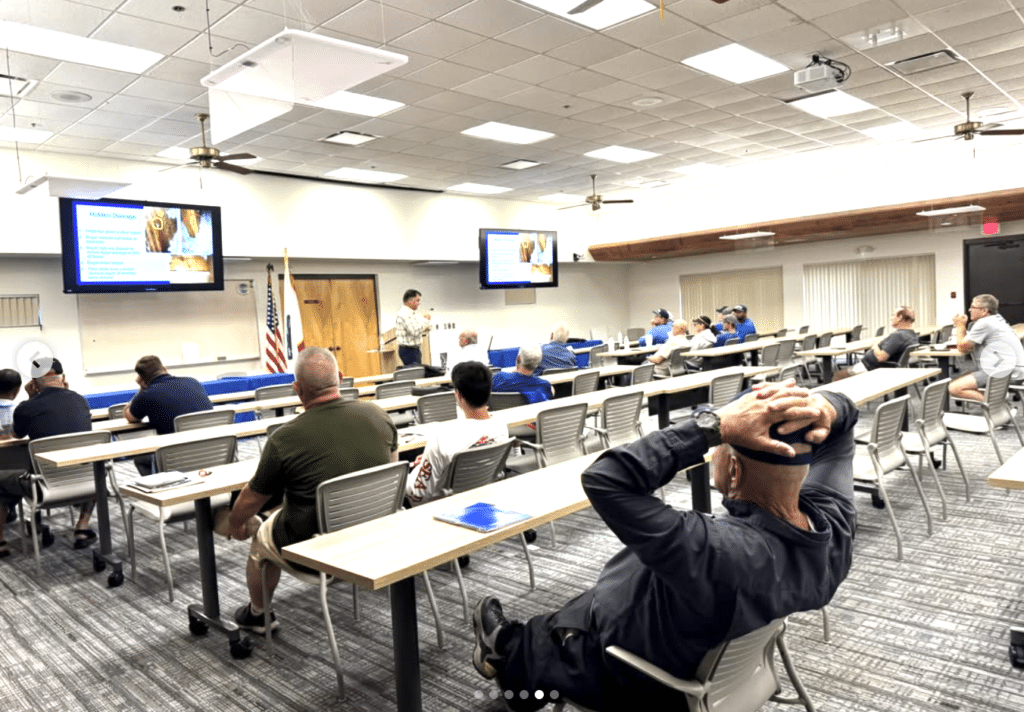
Most homeowners never see what happens before a technician shows up at their door. Part of that preparation happens once a month in a classroom, not a truck.
Every tech on our team sets aside a morning to sit through a lecture from Joe, our staff entomologist, covering pest biology and behavior in more depth than a typical field briefing allows. It is not a perk. It is a standing requirement.
The core of it
Pest control is a field where the research keeps changing. New findings on rodent behavior, termite damage patterns, and treatment resistance come out regularly, and a technician who only learns on the job tends to repeat the same assumptions year after year.
Monthly training with a working entomologist is how we keep that from happening on our team, and it is the kind of standing investment most pest control companies, including the national chains, do not make.
Years on the job teach a technician what usually works. They do not automatically teach why it works, or what changed in the underlying biology that made an old assumption wrong. A tech who only has field experience can get stuck repeating a method past the point it stopped being effective.
Joe's monthly sessions exist to close that gap before it costs a customer a callback.
These are not generic refreshers. Each session is built around specific, current material, and it shows in what a tech notices on a property afterward.
Identifying damage most inspections miss.
A recent session walked through how to spot hidden structural damage from wood-destroying pests, the kind that is easy to miss during a routine inspection if a technician does not know exactly where and how to look.
Discussion, not a one-way lecture.
Technicians bring up specific properties they are actively working and ask how the material applies to the exact situation they are seeing in the field that week. The session adjusts around real cases, not a fixed script.
Judgment on properties that do not fit the textbook.
South Florida homes vary widely in construction, age, and landscaping. A technician who understands why a treatment works, not just how to apply it, makes better calls on the properties that are the exception rather than the rule.
A technician who can explain what is happening on your property, not just recite a treatment plan, is the direct result of this kind of ongoing education. It also means more precise, targeted treatment rather than a broader application used because it is familiar rather than because it is correct for your situation.
If you want a technician who can explain exactly what is happening on your property and why, call Wise House Pest Control to schedule an inspection. Our team trains year-round so the answer you get is current, not inherited.

1177 Hypoluxo Rd Suite C-31 Lantana, FL 33462
464 NW Peacock Blvd, Unit 106 Port St Lucie, FL 34986
Sources
EPA — integrated pest management principles and pesticide reduction
UF/IFAS EDIS publication — integrated pest management for Florida residences
UF/IFAS EDIS publication — residential rodent management and exclusion requirements
ASPCA Animal Poison Control Center — pyrethroid sensitivity in cats