
"We have a concrete block home. Termites cannot get into concrete."
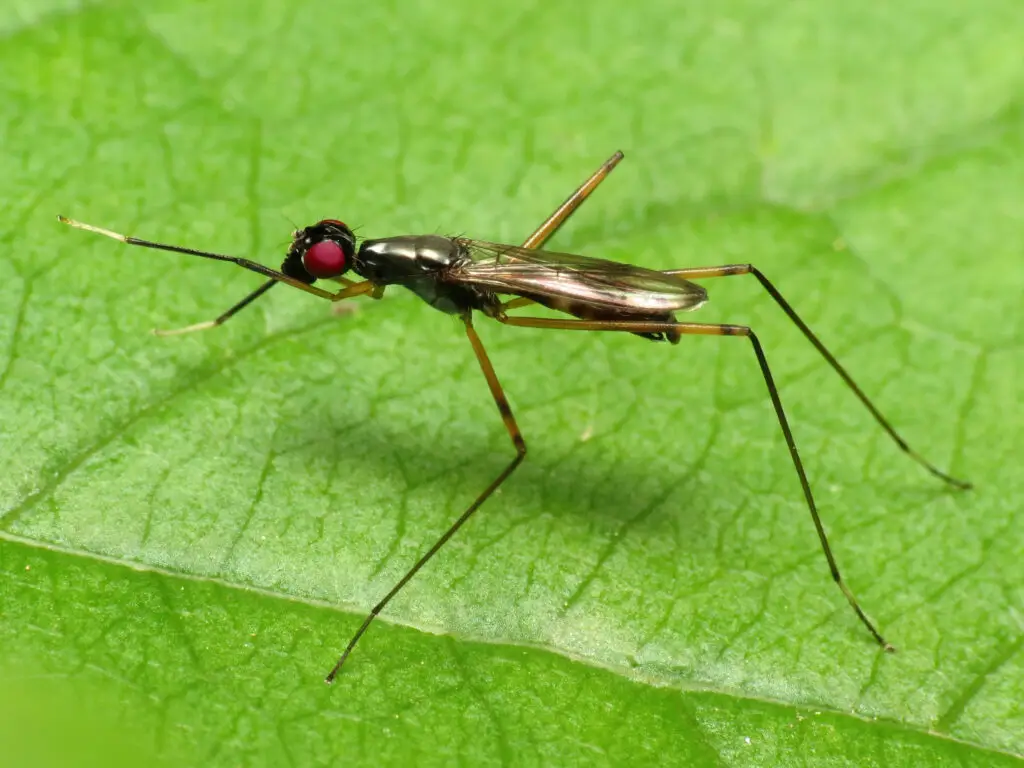
Stilt-legged flies belong to the family Micropezidae, a group of small, long-legged flies found throughout tropical and subtropical regions. The species most commonly spotted in South Florida backyards is Grallipeza nebulosa, a slender insect with legs so disproportionately long that it looks like it is walking on stilts. That is not a coincidence. The name fits.
The Micropezidae family includes over 500 described species worldwide, though only a handful are regularly encountered in Florida. Grallipeza nebulosa is among the most recognizable because of its distinctive behavior and the white tips on its forelegs that are visible even at a distance.
Males and females look slightly different. Males have the more uniform coloring you see in most photographs. Females have noticeably bright yellow abdomens, which makes them easier to spot when they are resting on vegetation in your yard around Boynton Beach or Port St. Lucie.
Here is where it gets interesting. That slow, deliberate leg-waving is not random. It is a defense mechanism, and a sophisticated one. The fly is mimicking a wasp.
Stilt-legged flies wave their brightly marked forelegs in the same way a wasp waves its antennae, mimicking the nervous, high-alert body language that predators associate with insects that sting. Some species even have an elongated section at the end of their abdomen that resembles a stinger. The whole performance is designed to make a small, soft-bodied fly look like a pointy, well-armed wasp.
Not every species in the family uses the same technique. Some wave their hind legs instead of their front legs. Others perform an elaborate backwards movement that mimics the movement patterns of local stinging ant species found throughout South Florida. The variation across species suggests this mimicry has evolved independently multiple times, which shows how effective it is as a survival strategy.
The scientific term for this is Batesian mimicry, where a harmless species evolves to resemble a dangerous one. It is common in South Florida insects. The viceroy butterfly mimics the monarch to avoid predation, one of the most well-known examples.

Stilt-legged flies have legs that are noticeably long relative to their body. The overall silhouette looks stretched and angular compared to a common house fly or blow fly.
The slow, rhythmic foreleg movement is the most reliable identifier. Very few flies in South Florida exhibit this behavior.
The pale or white markings on the forelegs are visible to the naked eye even on a small insect. This is what makes them identifiable at a distance.
Slender and elongated, with a narrow waist and an abdomen that tapers toward a point. On females, look for the bright yellow coloring on the abdomen.
They run and walk when disturbed rather than flying immediately. The movement looks deliberate and unhurried.
At Wise House Pest Control, we identify fly species across Palm Beach County and the Treasure Coast every week, and that identification step is what most homeowners skip before calling. Not every fly is a pest. But some fly activity does signal a problem nearby, and knowing the difference saves you time and money. If you are seeing flies inside your home, near food, or in numbers that seem unusual, we will figure out exactly what you are dealing with before recommending any treatment.

1177 Hypoluxo Rd Suite C-31 Lantana, FL 33462 (561) 727-8239
464 NW Peacock Blvd, Unit 106 Port St Lucie, FL 34986 (772) 783-4300
University of Florida Department of Entomology and Nematology — Micropezidae species diversity and Florida distribution
UF/IFAS Featured Creatures — stinging ant species whose movement stilt-legged flies mimic in South Florida
UF/IFAS Featured Creatures — viceroy butterfly Batesian mimicry, a parallel strategy to stilt-legged fly wasp mimicry
