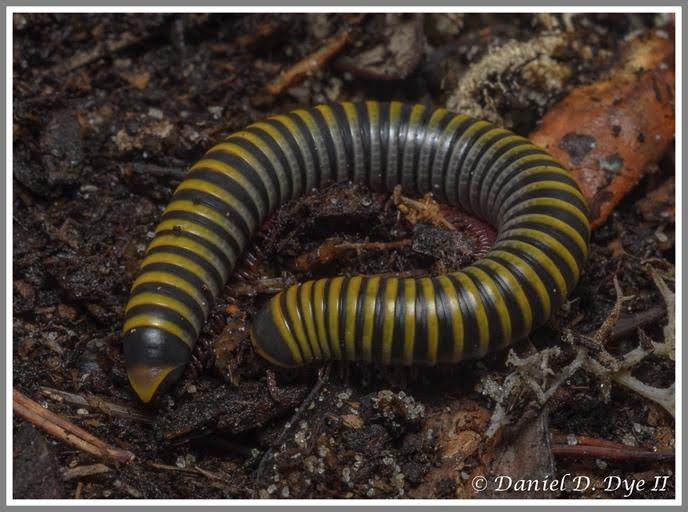
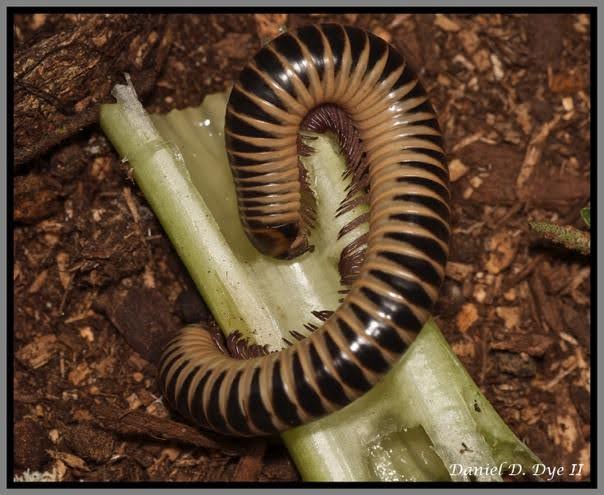
Almost like clockwork (depending on environmental conditions), millipedes migrate in large numbers and become quite a nuisance for many homeowners. This is nothing new…Large migrations have been occurring for many years, according to Walter Ebeling, author of Urban Entomology. Some migrations were so large, it became necessary to apply sand on slippery railroad tracks for traction of locomotive drive wheels due to the squished millipedes. In 1919, a millipede migration caused cattle to stop grazing because of the high numbers on the pastures. During this time, large quantities of drowned millipedes were found in wells, rendering the water unsuitable for drinking for a while. Also, field workers became sick while hoeing a cornfield because the millipede population was so great the hydrogen cyanide odor from the crushed millipedes overwhelmed them. Ebeling goes on describing several other occurrences in his publication.
Females may lay between 20-300 eggs depending on species. They lay there eggs in decaying organic matter or in soil cavities. The eggs are laid during the summer months; however in south Florida they may breed year round. The eggs will take several weeks to hatch. Adults have been known to live for several years.
Some species give off a smelly fluid from the sides of their body through small openings. This fluid is toxic to some small animals and arthropods. This fluid could cause small blisters in humans if handled.
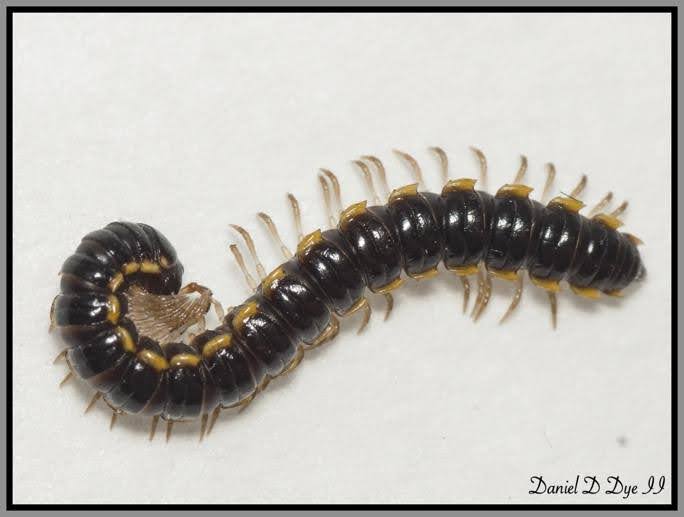
Millipedes have two pair of legs per body segment, as seen in the photo to the right. They strictly feed on decaying organic matter.
Centipedes have one pair of legs per body segment, as seen in the photo to the right. Most centipedes feed on insects and other small arthropods. Their bite contains venom to immobilize their prey. It’s not recommended to handle them because they can deliver a painful bite, but pretty much harmless otherwise.
Another millipede that occasionally migrates, but seldom in numbers to cause any alarm, is the Florida Ivory Millipede (Chicobolus spinigerus). This millipede is often seen crossing roads and sidewalks. On occasion, they may invade patios, but rarely in high numbers.
There are two species of Flat-Backed Millipedes that migrate in extremely high numbers when conditions are favorable. The first is known as the Greenhouse Millipede (Oxidus gracilis) and the second is sometimes called the Cyanide Millipede (Asiomorpha coarctata) because of its ability to secrete hydrogen cyanide. Sounds nasty, doesn’t it? The two look very much alike and are almost indistinguishable.
Unlike the Yellow-Banded Millipede and Florida Ivory Millipede, the Flat-Backed Millipedes are much smaller, ranging from about ½” to 1” in length. The smaller size allows them to enter homes and businesses through cracks in thresholds, sliding glass doors, windows, etc. The largest migrations usually take place in late summer and fall (September through November).
Most millipedes feed on decaying organic matter, such as leaves and dead plants. The Cyanide Millipede enjoys feeding on thatch build-up in grass, where it also breeds. So, they are considered very beneficial for the environment. It’s not until they invade your garage or carport and occasionally the interior of your home, they become undesirable…Go figure!
Controlling Migrating millipedes in South Florida can be a challenge due to their behavior and sometimes high populations. Knowing a little about their biology and habits will help considerably. Remember, their main source of food is decaying organic matter, such as turf thatch and decaying leaves.
Here are a few things you can do to prevent large infestations: