
Cane Toads in South Florida: The Backyard Pest That Can Kill Your Dog
Blog Post
- 10 Mins Read
It is a warm summer evening in Boca Raton. You let the dog out before bed. A few minutes later you hear something that stops you cold. Your dog is pawing at its mouth, drooling heavily, shaking. You look down and see a large, warty toad sitting a few feet away looking completely unbothered.
You have just met a cane toad. And you have about 15 minutes to act.
This is a scenario that plays out across South Florida neighborhoods every summer, and it happens far more often than most new residents realize. Cane toads are one of the most misunderstood backyard hazards in Palm Beach County and the Treasure Coast. Here is everything you need to know about them, why they are here, and how to keep your family and pets safe.
"We have a concrete block home. Termites cannot get into concrete."
Cane Toads South Florida Story: How Did They Get Here?
This is one of those wildlife stories that starts with the best of intentions and ends with an ecological headache that South Florida is still dealing with decades later.
According to the Florida Fish and Wildlife Conservation Commission, cane toads were first deliberately introduced to Florida in the 1930s and 1940s to control agricultural pests damaging sugarcane crops. The idea had worked in Puerto Rico, where cane toads had reduced beetle populations threatening sugarcane plantations. Scientists believed the same approach would work in Florida.
It did not work nearly as planned. According to UF/IFAS wildlife ecologists, the original introduced populations did not survive, but releases and escapes from exotic animal importers in the 1950s and 1960s established the populations that are now spread across central and southern Florida. What began as an agricultural pest control experiment became one of the state’s most persistent invasive species problems.
Today, cane toads are firmly established throughout South Florida. According to the Conservancy of Southwest Florida, they thrive in exactly the kind of environment that characterizes Palm Beach County and Treasure Coast neighborhoods: suburban yards, golf courses, canal edges, and any area with consistent access to water, insects, and light.
Why Cane Toads Explode in Summer
If you have lived in South Florida for a full year, you know that cane toad activity is dramatically different in summer than any other time of year. What you might see occasionally in the winter becomes an every-night occurrence from June through September.
There are two reasons for this. First, cane toads are most active in warm, wet conditions. Florida’s rainy season provides both, creating the standing water they need to breed and the humidity they prefer for foraging. Second, and this is the detail the owner mentioned that is genuinely fascinating: cane toads are powerfully attracted to artificial light.
The same porch lights, garage door lights, and front entry lights that you leave on in the evening attract moths, beetles, flying ants, and other insects. Cane toads figured this out a long time ago. They station themselves near light sources every evening because the light does the work of gathering their dinner for them. This is why South Florida homeowners consistently find large groups of cane toads clustered around garage doors and front entries on summer evenings.
Dog poop left in the yard is another significant attractant. Cane toads are omnivores that will eat almost anything, including feces, which draws flies and other insects that cane toads then eat. Keeping the yard clean of pet waste is a practical step that reduces toad activity near the home.
How to Identify a Cane Toad
This matters because Florida also has native toad species that are beneficial and should not be disturbed. The southern toad is the species most commonly confused with the cane toad.

Size.
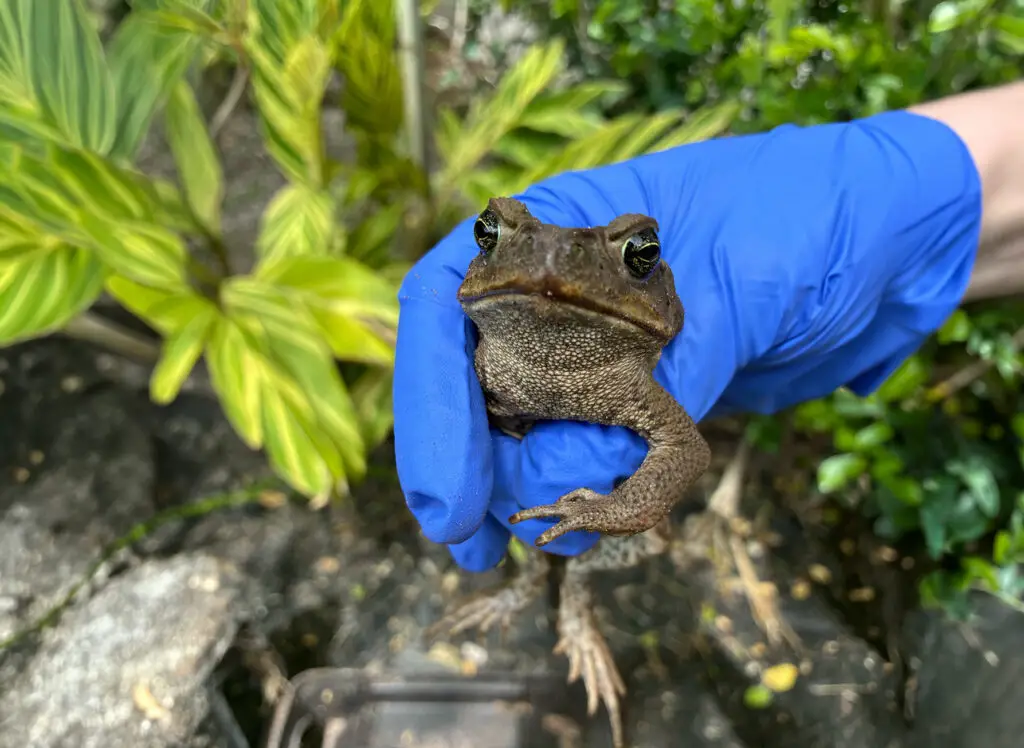
Adult cane toads range from 6 to 9 inches in length. Southern toads grow to only 3 to 4 inches. If you are looking at a toad that is noticeably large, larger than your fist, it is almost certainly a cane toad.

The head.
Southern toads have visible ridges or crests on their heads between the eyes that look like small horns. Cane toads have completely flat, smooth heads between the eyes. This is the most reliable identification feature.

The glands.
Both species have glands behind their eyes on their shoulders. The southern toad's glands are smaller and oval-shaped. The cane toad's glands are large and triangular, sometimes described as looking like shoulder pads. These are the glands that produce the toxic secretion.

Color.
Cane toads are generally reddish-brown to grayish-brown with a light yellow or beige belly. They can look almost identical to native toads in color, which is why size and head features are the most reliable identification tools.
Why Cane Toads Are Dangerous to Dogs
This is the part every South Florida pet owner needs to understand and remember.
Cane toads produce a milky white substance called bufotoxin from the large glands behind their eyes. This toxin is not injected like a venom and the toad does not need to bite your dog to cause poisoning. When a dog sniffs, mouths, licks, or bites a cane toad, the bufotoxin is absorbed through the mucous membranes of the mouth almost instantly.
Animals that bite or lick cane toads can become severely ill and die in as little as 15 minutes. Smaller dogs are at higher risk because the amount of toxin relative to their body weight is proportionally much greater. Cats are less likely to mouth toads than dogs but are not immune.
Signs of cane toad poisoning in dogs include:
- Excessive drooling and foaming at the mouth
- Pawing at the mouth and face
- Bright red gums
- Disorientation, stumbling, or loss of coordination
- Seizures in severe cases
- Collapse
If you suspect your dog has been exposed to a cane toad:
Rinse the inside of the dog’s mouth immediately with a garden hose or wet cloth, wiping from the back of the mouth forward to remove as much toxin as possible. Do not let the dog swallow the rinse water. Then contact your veterinarian or an emergency animal hospital immediately. Do not wait to see if symptoms develop.
How to Keep Cane Toads Away From Your Home
Wise House Pest Control does not remove cane toads since they are wildlife rather than pest insects. But reducing the conditions that attract them to your property in the first place is something every South Florida homeowner can do.

Turn off or redirect outdoor lights in the evening.
Motion-activated lights that only illuminate when needed reduce the insect gatherings that draw cane toads to your garage and entry doors. Consider yellow or amber bulbs, which attract fewer insects than white or blue-spectrum lights.

Remove standing water.
Cane toads breed in standing water and are attracted to it for hydration during hot evenings. Eliminating birdbaths, ornamental ponds without fish, and any container that holds water reduces toad activity on your property. This also reduces mosquito breeding at the same time.

Pick up pet food and water bowls at night.
Pet food left outside is a direct attractant for cane toads. Water bowls provide hydration. Both should be brought inside after evening feeding times during summer months.

Clean up pet waste promptly.
Dog waste in the yard attracts flies and other insects. Cane toads follow the insects. Keeping the yard clean reduces this food source.

Seal gaps under gates and fences.
Cane toads move through surprisingly small gaps. Hardware cloth with openings no larger than half an inch installed along the base of fences and under gates can significantly reduce toad access to enclosed yard areas.
If you need to remove a cane toad from your property, wear gloves and eye protection. Florida law allows property owners to remove and humanely euthanize cane toads from their own property. Do not relocate them. If you are not comfortable handling the toad yourself, contact a licensed wildlife trapper.
What Wise House Pest Control Can Help With
While we do not remove cane toads directly, we absolutely help reduce the conditions that make your property attractive to them. Professional mosquito control eliminates one of the primary insect food sources that draws cane toads toward your home in the evening. General pest control reduces the overall insect population around your exterior lighting. And our inspections can identify standing water and other harborage conditions that contribute to toad activity.
If you are dealing with pest issues around your home in Boca Raton, Boynton Beach, Port St. Lucie, or anywhere across Palm Beach County and the Treasure Coast, contact us today for a free inspection.
We Have Two Convenient Locations:
Lantana Office
1177 Hypoluxo Rd Suite C-31 Lantana, FL 33462 (561) 727-8239
Port St Lucie Office
464 NW Peacock Blvd, Unit 106 Port St Lucie, FL 34986 (772) 783-4300